
About RGM
The Ronnie Gardiner Method was developed by American jazz drummer Ronnie Gardiner in the 1980s. He set out to help children in their musical and motor development. It soon became clear that the method also works well for people with conditions of the central nervous system (stroke/ABI, Parkinson’s, MS and dementia).
In Sweden (where Ronnie Gardiner has lived for 50 years) he began training physiotherapists, speech therapists, music therapists and primary-school teachers as practitioners in 1993. Since then the method has been used in hospitals, rehabilitation centres, practices and schools. It has also shown positive effects for children and adults with learning and concentration difficulties (dyslexia, dyspraxia and ADHD), psychiatric conditions, burnout and/or depression, and for older adults as a healthy-ageing activity.
The method was first called RGRM. In 2013 the name was changed to RGM.
How it works
RGM uses rhythm, music, movement, speech, hearing, sight and touch in a playful way. While exercising, the participant reads the symbols and ‘translates’ them into the matching movement, performed to the rhythm of music. The colour of a symbol shows whether the movement is done on the right, the left or both sides. With the symbols, the RGM practitioner composes exercises (choreoscores) tailored to a group and to suitable music. While performing the movement for a symbol, you also say the name of that symbol. This activates several brain areas at the same time.
It may sound complicated, but the exercises are built up gradually and adapted to the level of the group or the individual. RGM can be adjusted to almost any level, from very simple to highly complex.
Because symbols are read (visual cortex) and translated into movement (prefrontal cortex and both temporal lobes), movements are alternated (motor cortex), words are spoken (language and speech centres) and music is heard, many brain areas fire together. That helps form new neural networks and strengthen existing ones: neurons that fire together, wire together.
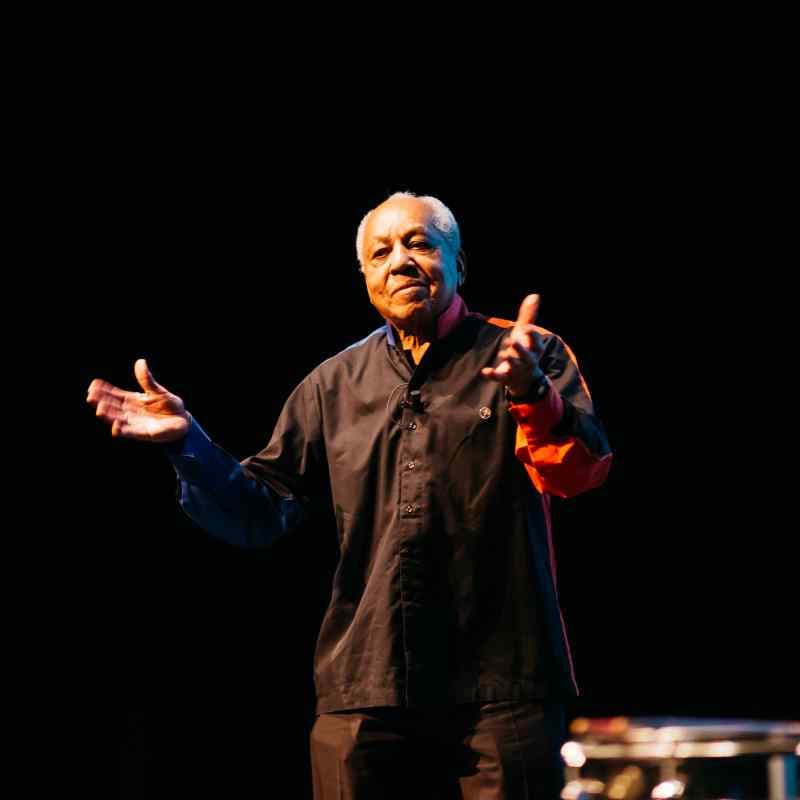
Ronnie Gardiner
RGM was developed by Ronnie Gardiner. Ronnie is a successful jazz drummer; he played with Dizzy Gillespie, Gerry Mulligan and Benny Carter, among others. A personal tragedy in 1980 led him to use his talent in a way that could help others. Over 13 years, through research and conversations with neuroscience experts, he developed his exercise method.
Despite his age (he was born in 1932) Ronnie still travels to train new RGM practitioners and to give workshops and lectures.
Results
No negative effects of RGM are known. There are many beneficial effects. How strongly someone experiences them differs and depends on age, motivation, health and how often they practise. Improvements are noticeable in children, adults and older people, in both ill and healthy people.
Possible effects of RGM:
- better concentration;
- better coordination;
- better motor skills;
- improved balance;
- better dual-task performance;
- faster thinking and cognitive switching;
- better speech, reading and learning;
- better social skills;
- more self-confidence;
- a better mood: people enjoy it;
- more energy.
Offer RGM yourself?
Would you like to give music a place in your daily practice? Become an RGM practitioner.
Become a practitioner